
How NVDA exposes online-shopping barriers, what the Coffee Beanery decision and Dizio docket actually establish, and why documented remediation is more useful than legal-immunity promises.
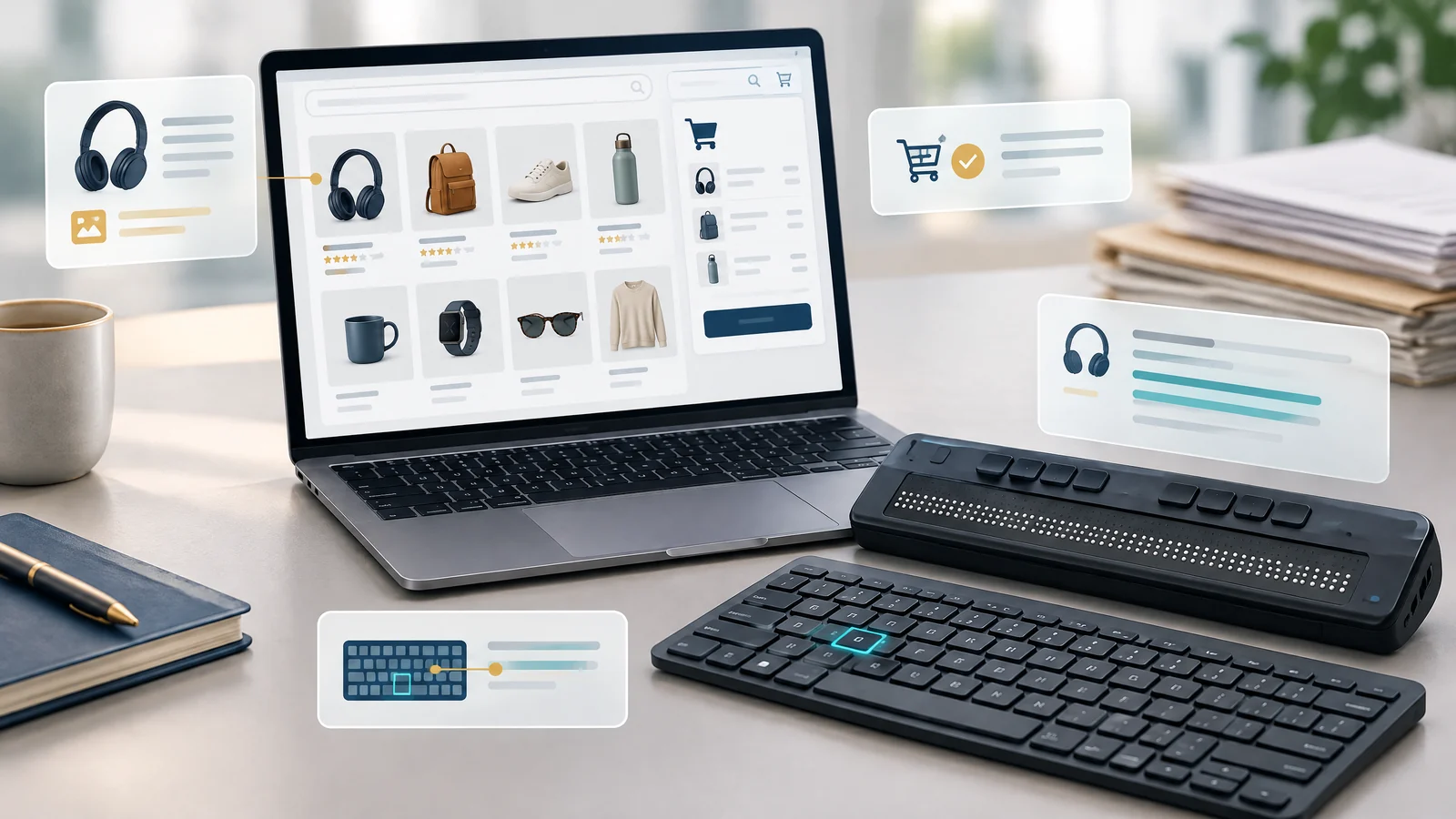
An online store can look complete while leaving a nonvisual shopper unable to identify a product, understand a price change or finish checkout. NonVisual Desktop Access, usually called NVDA, is NV Access’s free, open-source Windows screen reader. It provides speech and braille feedback and supports browsers including Firefox and Chrome. Its availability makes it a practical part of an accessibility test plan—not evidence that a website is automatically accessible or that every lawsuit uses the same software.
ADA website litigation has also focused attention on barriers that occur away from a physical entrance. The phrase intangible barrier describes a legal theory about access to a public accommodation’s goods, services or privileges. Understanding that theory requires reading the relevant court’s actual ruling. A complaint, a denial of dismissal and a settlement are different things; none should be turned into a universal litigation-defense promise.
Focus on usable customer journeys and documented evidence. Neither an automated scan nor a single screen-reader check establishes full WCAG conformance, and no audit or remediation program guarantees immunity from litigation.
How NVDA Navigates a Digital Storefront
In Browse Mode, NVDA presents supported web documents for reading and navigation. Users can move through headings, lists, links, landmarks and controls or use the Elements List to find important content. Those features depend on meaningful browser accessibility information: a visual heading needs heading semantics, a product image needs an appropriate alternative and a button needs a useful name and state.
Focus Mode passes ordinary typing and editing keys to controls that need them. NVDA can switch modes automatically depending on the control, navigation and user settings; NVDA+Space also toggles the modes. A test should respect those ordinary interaction patterns rather than require users to learn an undocumented custom keyboard system.
Modern JavaScript and single-page applications are not inherently incompatible with NVDA. The issue is whether their changing content remains understandable. An asynchronous cart update may need an appropriate status message. A modal needs a name, sensible entry and exit focus and correct keyboard behavior. A custom selector needs semantics and interaction that match its role. ARIA attributes alone cannot supply missing business logic or repair every interaction.
Common Shopping Barriers Worth Testing
Evaluate the complete journey rather than only the landing page:
- Product cards: useful image alternatives, meaningful product links and ratings or prices conveyed in text.
- Navigation and filters: understandable names and selected states, keyboard access and announced result changes or zero results.
- Dialogs and pop-ups: a programmatic name, appropriate focus containment for genuinely modal content, usable close controls and return focus.
- Cart changes: quantity, availability, subtotal and error information that remains perceivable without watching an animation.
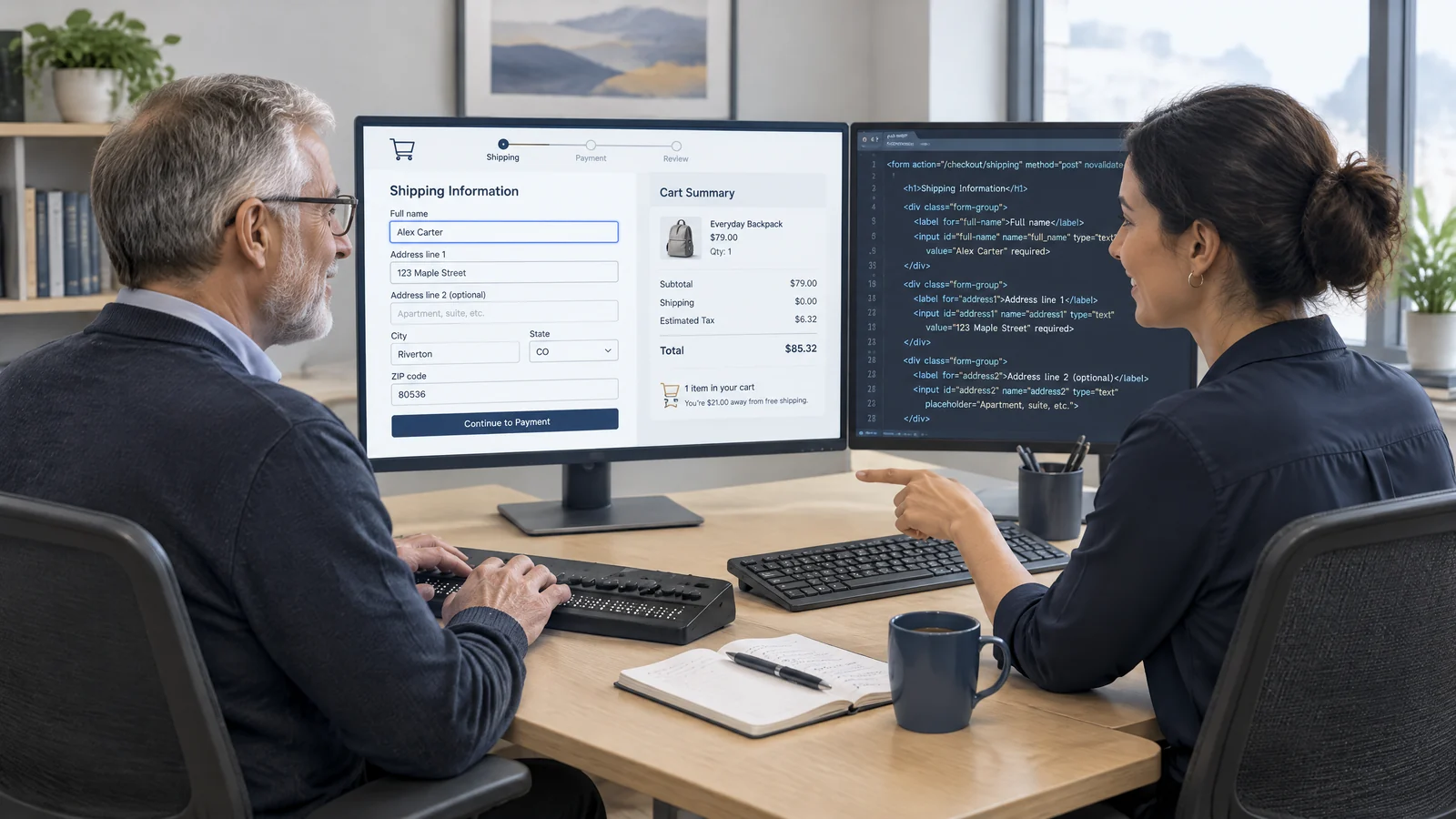
- Checkout: persistent labels, appropriate input types and autocomplete, logical keyboard order and actionable validation messages.
- Completion: delayed sending, rejection, repeated errors and success feedback that is available to assistive technology.
These are examples of barriers to investigate, not findings about every Shopify theme or every retailer. A platform name does not determine accessibility. Themes, custom scripts, payment integrations and third-party widgets must be reviewed in the actual deployment and intended user journeys.
Our NVDA Screen Reader Optimization Services for Oregon businesses connect a scoped native Windows/browser review with the semantic and interaction issues developers need to investigate. The test record should identify versions, settings, observed barriers and unresolved third-party boundaries.
What the Intangible-Barrier Theory Does—and Does Not—Establish
In the Eleventh Circuit’s Rendon decision, an off-site telephone selection process allegedly impeded access to a privilege of a physical public accommodation. The case illustrates that a barrier does not always have to be a physical step or doorway. It was not a blanket decision declaring every e-commerce website a public accommodation regardless of its connection to a physical place.
The unpublished Haynes v. Dunkin’ Donuts decision later reversed dismissal of allegations involving inaccessible shop-location and gift-card services. That ruling addressed the alleged relationship between website services and physical shops; it did not determine liability after a trial. It also identified JAWS, not NVDA. Do not infer a plaintiff’s software simply because a case concerns screen-reader access.
Different jurisdictions and case facts can affect the legal analysis. The vacated April 2021 Gil v. Winn-Dixie merits opinion should not be presented as binding circuit precedent. Businesses should ask qualified counsel to assess applicable obligations, standing and jurisdiction rather than treating a short case summary as a universal rule.
Ariza v. Coffee Beanery: A Claim Allowed to Proceed
On November 29, 2022, the Southern District of Florida denied motions to dismiss in Ariza v. The Coffee Beanery, Ltd. The opinion found the allegations sufficient at the pleading stage, where well-pleaded facts are treated as true. The plaintiff alleged connections between the website and physical stores, including a Sunrise store he said he intended to patronize, online sales, gift cards and store information.
The court allowed the claim to proceed; it did not establish after trial that the defendants had violated the ADA. Nor does that decision support an unrestricted rule that the physical-store relationship or the plaintiff’s stated intent never matters. The useful lesson for a business is to examine the online services customers actually rely on, not to overstate a preliminary procedural ruling.
What the Ariza v. Dizio Docket Shows
The public docket for Ariza v. Dizio LLC, No. 1:25-cv-22919, records a complaint filed on June 30, 2025, discovery-related administration, a settlement notice on July 9, administrative closure on July 10 and a voluntary dismissal with prejudice on July 23. The July 10 entry cancelled deadlines and denied pending motions as moot.
Those entries establish a procedural sequence, not liability, a payment amount, the settlement terms or the parties’ motives. Discovery referral is case administration, not a finding of wrongdoing. Settlement and dismissal should not be described as proven capitulation, and the displayed docket does not establish which screen reader the plaintiff used.
Review the PacerMonitor judicial docket for Ariza v. Dizio LLC (opens in a new tab) to distinguish recorded filings and closure from a contested decision on the ADA merits.
High-Volume Filing Claims Need Evidence, Not Assumptions
Repeated filing patterns may be relevant to a particular legal analysis, but a numerical claim needs a named dataset, date range, methodology and accurate treatment of cases. Calling parties a cartel, attributing a predatory motive or assuming an automated NVDA audit strategy goes beyond what these records establish. A business does not need those unverified accusations to justify improving access for customers.
Fee provisions also require care. Under 42 U.S.C. § 12205, a court or agency may, in its discretion, allow a prevailing party a reasonable attorney’s fee, including litigation expenses, and costs. That is not an automatic award whenever someone files a complaint, reaches a settlement or obtains a procedural ruling. Counsel should assess the actual case and available remedies.
Build a Practical NVDA Testing and Remediation Plan
Start with the tasks a customer must complete: finding a product, selecting an option, adding it to the cart, entering details, handling an error and understanding completion. Combine a source-code review and applicable WCAG criteria with actual NVDA testing on named Windows/Firefox and Windows/Chrome versions. Keep separate JAWS and Apple VoiceOver checks for those user environments; passing one product does not prove all assistive technologies behave identically.
A useful workflow records the observed barrier and the evidence of its correction:
- Agree the templates, user journeys, third-party boundaries and applicable WCAG targets before testing.
- Review semantic headings, landmarks, product alternatives, lists, control names, states and form labels.
- Use NVDA Browse/Focus Mode and keyboard navigation through filters, modal dialogs, cart updates and checkout.
- Test delayed submission, repeated validation, API rejection and completion using a safely intercepted environment rather than real customer transactions.
- Correct confirmed source-level defects and retest the original journey, adjacent components and regression cases.
- Document exact platform versions, settings, remaining vendor limitations and what was not evaluated.
For teams seeking NVDA Compatibility and Testing Solutions in Las Vegas, that evidence-based approach supports a developer-ready repair plan without pretending to reproduce a named plaintiff’s software or promising protection from every legal claim.
This is general educational information, not legal advice. Allegations, pleading decisions, settlements and final merits judgments have different meanings. WCAG 2.2 is a useful technical reference, not an automatically universal codified private-business Title III standard. No audit, platform, overlay or remediation program guarantees legal immunity; native NVDA results require actual execution on the named platforms.
Find the barriers in your website’s important shopping and inquiry journeys. Request a scoped audit with a documented native-testing and source-remediation plan.
Request an audit today.- NVDA
- ADA Title III
- E-commerce Accessibility
- Intangible Barriers
- Oregon
- Las Vegas
Randy is the founder of Optimize Media Marketing and has 15+ years of digital marketing experience helping Oregon home service contractors dominate local search.